12 March 2025
By 2030, all of DSB's current oil and gas boilers must be replaced with more sustainable alternatives. That process is well underway, and at DSB's large conference centre Knudshoved, new heat pumps are now benefiting both the climate and the facility's finances.
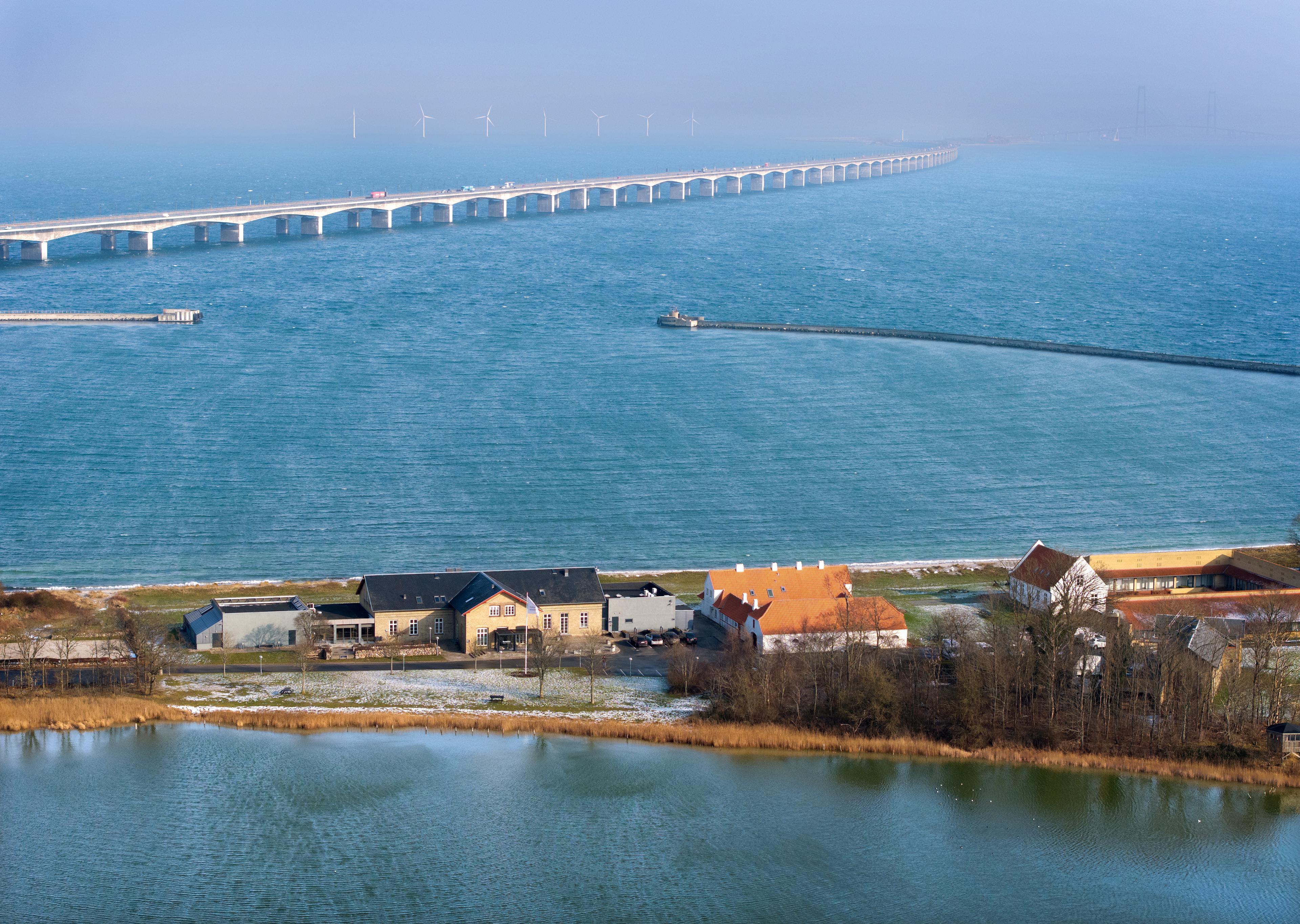
Where the Great Belt ferries once sailed from Nyborg to Korsør, DSB's large conference centre Knudshoved is located. Every year, 20,000 guests – both DSB employees and private companies – visit to enjoy the peaceful surroundings by the bridge and the strait.
This requires a great deal of energy for heating water and radiators, and until December last year, Knudshoved accounted for more than half of DSB's total fuel oil consumption.
But that is no longer the case. As DSB works purposefully to meet its environmental targets of halving energy consumption and reducing the climate impact from its own operations by 98 percent by 2030, the remaining oil and gas boilers in DSB's buildings are continuously being replaced with district heating and heat pumps.
Experience shows that the transition to district heating or heat pumps can reduce climate impact by 50–80 percent.
And in 2024, it was the turn of DSB's Conference Centre Knudshoved to have heat pumps installed. Specifically, five interconnected air-to-water heat pumps were installed, drawing heat from the air and using it for heating purposes.
As a result, very little smoke now emerges from the tall, yellow chimney that has stood on the site since the days when DSB's ferries connected Funen and Zealand.
"It is really good for my budget as a facility manager, and I am pleased that we no longer hold the title of DSB's biggest oil consumer," René Nygaard, department manager at Knudshoved Conference Centre
Saving 136 tonnes of CO2 equivalents
From approximately 63,000 litres of oil per year, consumption has now dropped to a fraction of that, as the new heat pumps handle the primary heating and supply the conference centre's many buildings with hot water and radiator heating.
Until the new system has been fully tested under various weather conditions, however, a decision has been made to retain one of the two oil boilers as a precautionary measure. The estimate is that approximately 9,000 litres of oil will still be needed per year, meaning the conference centre achieves an annual saving of approximately 54,000 litres of oil.
The switch to heat pumps thus delivers an expected annual saving of approximately 136 tonnes of CO2 equivalents, as well as a significantly lower heating bill.
CO2 equivalents are a measure used to compare the emissions of different greenhouse gases based on their potential to contribute to global warming.
These savings are a source of great satisfaction for René Nygaard, who has been department manager at Knudshoved Conference Centre for 25 years.
"It is really good for my budget as a facility manager, and I am pleased that we no longer hold the title of DSB's biggest oil consumer," says René Nygaard, who has so far been surprised by the scale of the savings the heat pumps are delivering.
Since the new system was connected in December 2024, the expectation is that Conference Centre Knudshoved will save over 200,000 kroner per year on heating.
At the moment, several of the venue's 52 rooms are also being comprehensively renovated, with underfloor heating being installed in the bathrooms, which pairs well with the use of heat from heat pumps.
"It is fantastic, and it makes a huge financial difference. I have thought a lot about how everyone should switch to heat pumps, because it simply works and is much cheaper," says an enthusiastic René Nygaard.
The goal is in sight
Since 2021, DSB has converted 24 oil and gas boilers, and in 2025 the target is to replace a further 20, which are primarily used to heat DSB's station buildings.
In total, there are 132 remaining oil and gas boilers to be converted by 2030 at the latest, and in this effort DSB is following the district heating companies' rollout of district heating to areas not yet covered.
And where district heating is not available – or where the rollout is simply too slow – heat pumps will be used to reach the target.
There are good reasons for this, explains DSB's Head of Sustainability, Aske Mastrup Wieth-Knudsen.
"For the sake of the climate and our energy consumption, replacing oil and gas boilers is the right thing to do. DSB has a long-term goal of reducing our emissions in line with the Paris Agreement, and we intend to live up to that," he says.
Overall, energy consumption from DSB's building stock accounts for approximately 10 percent of the company's total energy consumption, and it therefore matters greatly how heating is carried out, he explains.
"District heating and heat pumps are generally far more energy-efficient than oil and gas boilers, and at the same time contribute to a lower climate impact. Focusing on this is also important for our credibility in terms of sustainability – a credibility that is crucial for us as a company across several parameters," concludes Aske Mastrup Wieth-Knudsen.